

It is a warm evening in southeast Michigan, the summer of 2026. You have done everything right. No dodgy street food, no undercooked mystery meat, no gas-station sushi. You order the responsible thing: a crisp, fresh salad. Green, virtuous, healthy. You barely taste the handful of shredded lettuce on top, and why would you? It looks perfectly clean. What you cannot see is that a few of those glistening leaves are carrying passengers: microscopic spheres, thousands of them, each one a tiny time bomb that has been patiently waiting in the environment for over a week to become dangerous. You swallow. Nothing happens. For about seven whole days, nothing happens at all. And then, without warning, your intestines declare war. Welcome to cyclosporiasis, one of the few foodborne nightmares where eating your greens is exactly what gets you.

What is Cyclospora?
Meet Cyclospora cayetanensis, the single-celled parasite behind an intestinal illness called cyclosporiasis. It is not a virus and not a bacterium. It is a protozoan parasite, a member of the phylum Apicomplexa, which makes it a distant cousin of some infamous relatives: Toxoplasma and the Plasmodium parasites that cause malaria. Of the many Cyclospora species out there, only this one has learned to make humans miserable. We are, as far as we know, its favourite and pretty much only host.
The infectious package it travels in is called an oocyst: a tough little sphere just 8 to 10 micrometres across (you could line up roughly a thousand of them across a single grain of salt). Inside that shell, once the parasite is fully armed, sit two smaller capsules, and inside those sit four sporozoites, the commando units that actually break into your gut lining. When you swallow a mature oocyst, those sporozoites pop out in your small intestine, burrow into the cells of your jejunum, and start multiplying. The result is inflammation, damaged intestinal cells, and the symptoms your body is about to complain very loudly about.
The parasite that plays the long game
Here is the single strangest thing about Cyclospora, and the fact worth remembering above all others: you almost certainly cannot catch it from another sick person.
That sounds impossible for a gut parasite spread through faeces, but it comes down to timing. When an infected person sheds oocysts, those oocysts are not yet infectious. They are duds. To become dangerous, a freshly shed oocyst has to sit outside the human body for at least a week, and often one to two weeks, under the right warm and humid conditions, going through a maturation process called sporulation. Only after it has sporulated can it infect someone new.
This built-in delay is why cyclosporiasis behaves so differently from something like norovirus. You cannot get it by shaking hands with a patient, sharing a bathroom, or caring for a sick relative. What you can do is eat fresh produce that was contaminated in the field, days or weeks earlier, by water or soil carrying already-sporulated oocysts. The parasite does not need a person-to-person chain. It just needs the food supply and a little patience.
Why washing your salad will not save you
Your instinct is to reach for the tap and rinse those greens. It is a good instinct. Unfortunately, against Cyclospora it is not nearly enough.
The oocyst's double-layered wall makes it a genuine survival machine. It shrugs off freezing, it survives in the environment for long stretches, and, most inconveniently, it is resistant to chlorine at the concentrations used to disinfect food and water. The oocysts are also unusually sticky: they cling to the surface of produce more tenaciously than Giardia or Cryptosporidium do. Careful washing and sanitising can reduce the number of oocysts on a leaf, but studies are clear that these steps do not reliably remove them all. There is no home kitchen trick that guarantees a contaminated salad is safe.
This is exactly why Cyclospora outbreaks are so hard to stop once contaminated produce enters the supply chain, and why prevention has to happen upstream, in the field, through clean irrigation water, good sanitation, and healthy agricultural practices, rather than at your kitchen sink.
Meet the symptoms
After that quiet incubation period of about a week (the range runs from roughly two days to two weeks), the parasite makes its presence extremely known. The signature symptom is frequent, watery, sometimes explosive diarrhoea, often with a maddening on-again, off-again pattern that can drag on for weeks if untreated. The rest of the guest list includes:
- Nausea and vomiting
- Loss of appetite
- Stomach cramps and intestinal pain
- Bloating and excessive gas
- Fatigue
- Noticeable weight loss
- Low-grade fever
Left untreated, cyclosporiasis can drag on for weeks, and in stubborn cases considerably longer, with the diarrhoea sometimes fading for a few days before roaring back for another round. It is rarely fatal in otherwise healthy people, but the relentless diarrhoea can cause dangerous dehydration, and that risk climbs sharply in the very young, the elderly, and anyone with a weakened immune system.
Michigan 2026: the biggest outbreak in US history
Which brings us to why Cyclospora is suddenly headline news. In 2026, Michigan became the epicentre of the largest cyclosporiasis outbreak ever recorded in the United States, and it is not even close.
To put that in perspective: before this, the biggest Cyclospora outbreak on US record had sickened around 1,500 people, back when contaminated raspberries were the culprit. Most large outbreaks never crossed 1,000 cases.
Michigan blew past those numbers many times over. As of early August 2026, the Michigan Department of Health and Human Services reported roughly 12,485 cases tied to the outbreak, with 279 hospitalisations and 2 deaths. Both people who died had significant underlying health conditions, and both became ill before the food recall described below. Nationally, the picture is just as striking: the CDC confirmed more than 10,000 laboratory-verified, domestically acquired cases across dozens of states since the start of May 2026, with thousands of additional suspected cases still under investigation, a large share of them from Michigan. The agency was concerned enough to issue a formal Health Alert Network notice to clinicians and laboratories.
Cases clustered heavily in southeast Michigan, with counties such as Monroe, Lenawee, Washtenaw, Wayne, Shiawassee, Jackson, Oakland and Livingston hit hardest.
So what was the source? Investigators pointed to lettuce and salad greens, based on more than a thousand patient interviews. In mid-July 2026, Taylor Farms recalled iceberg lettuce sourced from central Mexico, a product linked to a multistate cluster that included lettuce served at Taco Bell, and pulled it from the supply chain. It is worth being precise here: public health officials were investigating several separate Cyclospora outbreaks at once during the summer, and not every case has been tied to a single confirmed source. By early August, with cases trending downward, Michigan lifted its earlier advice to avoid bagged salad greens.
There is a bigger lesson lurking in the data. For years, cyclosporiasis in the US was mostly an "imported" problem, tied to produce from other countries. Outbreaks like this one add to growing evidence that Cyclospora now has a foothold much closer to home, which makes clean water and sanitation in domestic agriculture a rising priority.
How do you actually get rid of it?
Good news: unlike the salad on your plate, the parasite inside you is treatable. The standard treatment for cyclosporiasis is the antibiotic combination trimethoprim-sulfamethoxazole (often known as co-trimoxazole, or by the brand name Bactrim). It clears the infection and shortens the misery considerably.
The catch is that there is no strong, well-established alternative for people who are allergic to sulfa drugs, which makes treatment genuinely tricky for that group. And because Cyclospora is a parasite, not a bacterium in the usual sense, it will not respond to the antibiotics you might reach for against ordinary food poisoning. It also gets missed by standard stool test panels unless a doctor specifically orders testing for it, so if a watery diarrhoea drags on for more than a few days after a salad, it is worth mentioning Cyclospora by name.
Staying off the menu
Because you cannot scrub or chlorine your way to a guaranteed-safe leaf, prevention is mostly about awareness:
- Pay attention to active recalls and outbreak advisories for fresh produce, and follow them.
- During a known outbreak, take official guidance on specific products (like bagged greens) seriously while it is in effect.
- Wash produce anyway. It lowers the risk even if it does not eliminate it, and it helps against plenty of other nasties.
- Support the boring, upstream stuff that actually works: clean irrigation water, good agricultural hygiene, and proper sanitation on farms.
Gameplay Guide: unleashing Cyclospora in ImmunoWars
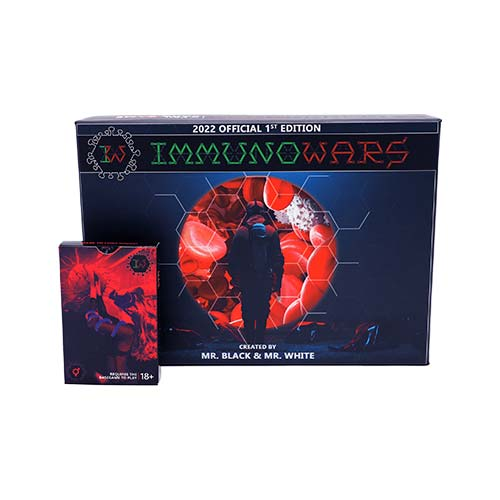
Good news for the strategically sinister: Cyclospora cayetanensis is a real card in ImmunoWars, and it plays exactly as nastily as it sounds. Meet "Diarrhea Olympics."
The flavour text says it all: this parasite has crept its way into the supply chain of a multimillion-dollar fast-food business by hiding in iceberg lettuce. Sound familiar? It should. That is the 2026 outbreak, immortalised on a playing card.
Here is what makes it so deliciously cruel to deploy:
- You do not choose the damage. Your victim rolls for it. When you infect an opponent with Cyclospora, they grab a die and discover their own fate. Roll a 4, 5 or 6 and they get off relatively lightly: mild diarrhoea and stomach cramps for -1 HP every turn. Roll a 1, 2 or 3 and it is the explosive, intense-pain version for -2 HP every turn. Either way, the losses keep coming until they deal with it.
- A severity of 2 stars. The two filled stars in the bottom-right corner tell your opponent how hard they will have to work to shake it off. This is a proper, medicine-tier problem, not something a quick consumable can rinse away.
- Contagiousness of zero. Look at the bottom-left corner: three biohazard circles, all empty. That is not a printing quirk, it is biology. Because real Cyclospora does not spread from person to person, this card carries no contagiousness, which means no risk of co-infecting yourself when you attack. Pure, guilt-free sabotage.
- The gift that keeps on giving. As the card reminds you, untreated infections can last 10 to 12 weeks, with the diarrhoea sometimes vanishing briefly before returning for another round. On the board, that means an opponent who ignores it is in for a long, draining haul.
Want to wage biological warfare without the hospital bill? Get ImmunoWars here.
References
-
- Michigan Department of Health and Human Services (MDHHS). Cyclosporiasis Outbreak 2026 and Infectious Disease Outbreaks. Available from: https://www.michigan.gov/mdhhs/keep-mi-healthy/infectious-diseases/infectious-disease-outbreaks
- Centers for Disease Control and Prevention (CDC). Surveillance of Cyclosporiasis, 2026. Available from: https://www.cdc.gov/cyclosporiasis/php/surveillance/index.html
- Centers for Disease Control and Prevention (CDC). About Cyclosporiasis. Available from: https://www.cdc.gov/cyclosporiasis/
- Ortega YR, Sanchez R. Update on Cyclospora cayetanensis, a Food-Borne and Waterborne Parasite. Clin Microbiol Rev. 2010 Jan;23(1):218-234. Available from: https://www.ncbi.nlm.nih.gov/pmc/articles/PMC2806660/
- Kansas State University, Department of Parasitology. Cyclospora cayetanensis life cycle and basic biology. Available from: https://www.k-state.edu/parasitology/cyclospora/cyclospora.html
- CNN Health. Tracking the largest cyclosporiasis outbreak in the US, 2026. Available from: https://www.cnn.com/2026/07/21/health/cyclospora-cases-count
- Infection Control Today. Cyclosporiasis Outbreak 2026: Confirmed Cases Across Multiple States, 2026. Available from: https://www.infectioncontroltoday.com/view/cyclosporiasis-outbreak-2026-1-645-confirmed-cases-34-states-with-growing-cluster-michigan-ohio-west-virginia-kentucky
- University of Florida IFAS Extension. Preventing Foodborne Illness: Cyclosporiasis (FSHN0519). Available from: https://ask.ifas.ufl.edu/publication/FS130